The building made of nine giant iron atoms
And other interesting and quirky things from the overlap of science, art and history
A few weeks ago I was in Brussels, where I took this picture of the Atomium. What you’re looking at is a building with two floors in each sphere and hallways that connect them via stairs or escalators. It is also the molecular crystal structure of iron.
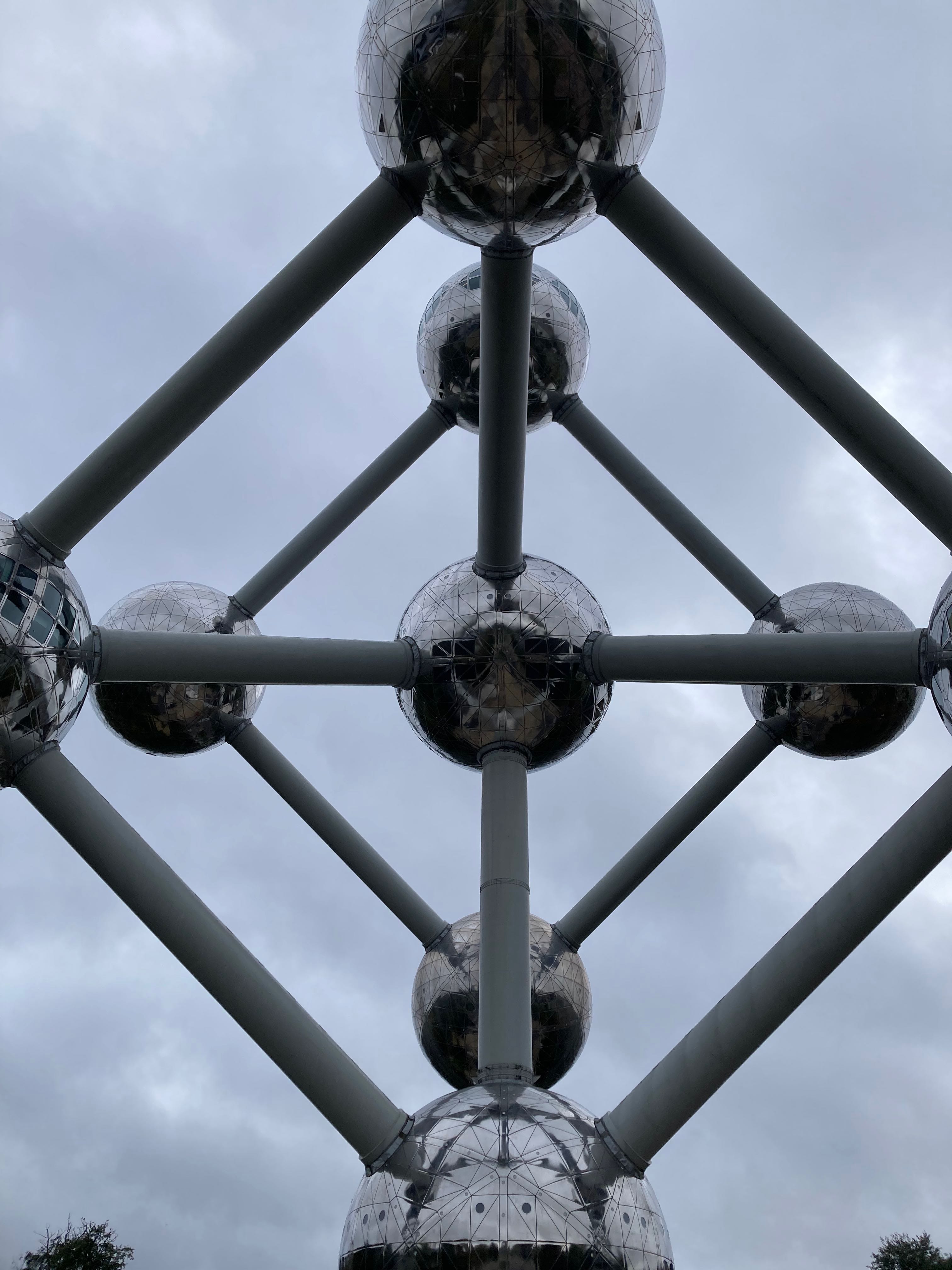
The Atomium was designed by engineer André Waterkeyn and architects André and Jean Polak. It was built for the 1958 World’s Fair in Brussels to celebrate science. This was the age of the space race and of rapid developments in home technologies, so everyone was really hyped about science. Creating a building in the shape of a molecule just seemed like an obvious thing to do.
The structure is made of stainless steel – iron combined with chromium and nickel – and even its shape represents iron. Specifically, it’s the crystal structure that iron atoms take on at room temperature. It’s called a “body-centered cubic” structure because it’s essentially a cube shape with atoms on all eight corners and one in the middle of the cube. The Atomium has the cube balancing on one of its corners, but it’s still a cube.
As far as I know this is the only building shaped like a molecule. (Sure, London has the O2, but it’s just a dome and not even shaped like two oxygen atoms...) So if you want to be inside an iron atom, Brussels is the place to be.
💡 Interesting Links
The home science labs of English noblewomen. By Livia Gershon for JSTOR Daily.
Archaeologists find the first red paint made from plants. By Brian Handwerk for Smithsonian Magazine.
Science sit down: Nan Li explains how art helps us understand research. Interview by Laila Smith for the Daily Cardinal at University of Wisconsin-Madison. (I’ve written about Li’s work before over on Forbes.com)
Croaking frogs, buzzing hornets, squealing dolphins: a guide to Smithsonian Folkways’ best science and nature recordings. By Philip Sherburne for Pitchfork
The scientist who decodes the songs of undersea volcanoes. A profile of Jackie Caplan-Auerbach by Robin Andrews for Quanta Magazine.
Support Mixture
I’m a freelance science writer, and writing this newsletter takes up a few hours of my time each week during which I can’t take on paid work. If you would like to support Mixture with a one-off donation, you can do so via Buy Me a Coffee.
You can also become a paying subscriber with the link below and get access to all archives, comments and occasional extra posts such as this one about the science behind a Simon and Garfunkel song or this one about Covid, art and the city of Medellín.


