

I know nothing about research
The path from scientific research to public knowledge is a hot mess, but I love when people talk about the process.

Just want some quick links to science on the internet? That’s near the bottom of the newsletter!
It’s a problem as old as Socrates: the realization that you don’t actually know anything. (Or at least, you know that you’re missing knowledge). The solution is the same now as it was two millennia ago: you do research. But what people mean when they say that they’ve “done research” is not always the same.
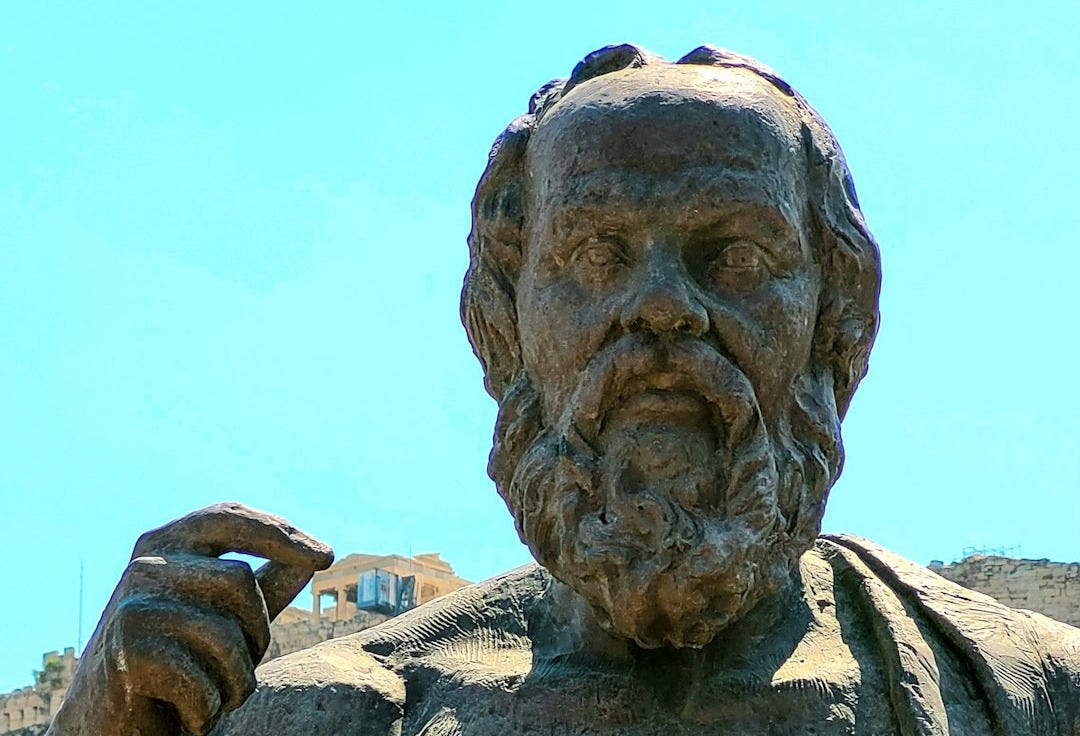
On the internet, “do your own research” means “look at some websites”, but in academia it broadly means “spend years of your life studying a tiny thing until you’re the person who knows most about it, but still not everything.”
The way that research is done and how it’s shared with other researchers is not always clear to people who aren’t involved in it directly, so it was great to see one of my favourite YouTubers tackle the topic. I’ve been watching Wheezy Waiter for about 15 years, and this might be the first time that one of his videos makes it into one of my newsletters. (But I’m fairly certain that I’ve linked to one of his Good Stuff videos years ago.)
For science communicators this is all standard knowledge, but I loved seeing it being discussed for and by people outside of this bubble. Because we’re ALL “doing research” on the internet, and at the very least it’s important to know how to do that properly!
The video also reminded me of another video that I linked in the previous newsletter, but which very few people actually looked at, so here it is again. It’s a video by independent journalist Christophe Haubursin (formerly of Vox) in which he tries to figure out how (and why) people buy fake scientific publications. It’s another topic that I knew a lot about already, because I used to work for scientific publishers and spent time with people who made it their entire career to figure out how to avoid this problem.
It’s such a huge problem to have the scientific literature full of papers that aren’t really describing actual research. If you watched the first video, you can see how important these papers are as a source of original research. Even if you don’t expect them to be the final word on a topic (they never are), you at least expect them to describe real scientific data.
If researchers or publishers find that an already published article was very flawed (or outright fake) it can be retracted, but at that point it has already been out there and people have talked about it. Science journalists publish news based on which new studies come out. When these same papers are retracted a few months later, they don’t notify all the newspapers and magazines that covered the initial publication, so you don’t usually hear about it. (This is why most people probably don’t realise that the whole idea that vaccines supposedly cause autism comes from ONE research paper that has since been retracted because it was flawed. People remembered the initial news and it caused such widespread fear but they never heard that the paper was retracted. Children literally died of measles because people don’t know about retractions.)
Seeing which papers get retracted is also really interesting. Apparently, papers from China get the most retractions. The demands on researchers in China have traditionally been really high, and even doctors needed to publish a certain number of research papers. Research doesn’t always fit neatly into a timeline, so you end up with situations where people who weren’t quite ready to publish their work still had to publish something quickly. They might later realise, with more data, that these rushed papers didn’t quite match the reality of the research, which leads to retractions.
But wait, there’s another problem. This week I learned that even genuine research papers that don’t have any mistakes in the research itself can be published with fake references! Every research paper has to cite the work of other researchers, so that the work can be placed in context of what other people have done. Each journal will want their references in a specific format, and journals published by Elsevier have long had an example on their site with a made-up paper, just to show people how to format their citations. Apparently, a lot of people accidentally left the example in, and now that fake paper has 1500 citations in Google Scholar.
Even worse, AI is also introducing fake references into papers. There was a whole article in Nature about how to detect these fake references, but I’m more interested in how it happened. I think it’s because people are using AI as a final step to help with grammar and phrasing. So they feed it a close-to-finished version of the paper that already has the references in place. AI doesn’t understand what references are, but sees a bunch of them in the text, and thinks that it needs to add another reference-shaped thing in there. When it slips in a fake reference in between real ones, or edits a real one to become fake, it’s not easy to spot on a final read-through, so these papers get submitted like this. Again, this is just what I think happens. I’m waiting for the experts (scholarly publishers or librarians) to do a full analysis on it.
All these things put together just show how incredibly complex things can get. Or, as I phrased it in my notes for this: the path from scientific research to public knowledge is a hot mess.
Most people don’t have a good overview of how this all works. How do scientists do research? How do they share it? How do scientific publications operate? (And how *should* they operate, which is an entirely different issue.) How do journalists find out about new papers? How do newspapers and magazines decide what to share with the rest of us?
I’m in a unique position in that I’ve worked on all parts of this path: I used to be a researcher, then spent years working for scientific publishers, and now I’m a science journalist. But even I don’t fully understand all of it and still rely on experts to look at the details. Like Socrates, I know that I know nothing.
Science on the internet
‘This feels fragile’: how a satellite-smashing chain reaction could spiral out of control. A very cool interactive article on The Guardian, about a scary topic.
A ‘doomsday vault’ of microbes could save species—including us. By Ashley Stimpson for C&EN
Antibiotic resistance in India has consequences everywher. By Assa Doron and Alex Broom for Aeon.
“Why not merge balloon storytelling with my science book to create a science show?” HerCanberra profiles molecular biologist and balloon artist Chloe Lim
NASA has uploaded some amazing photos from the Artemis II expedition to the moon.
Mixture tip jar
I’m a freelance science writer, so I lose money by doing things that aren’t directly pitching/writing articles for magazines. This newsletter is costing me more than it makes at the moment, so any help is appreciated!
If you want to help out and can’t commit to being a paid subscriber, you can donate a small one-time amount in the virtual tip-jar hosted by Buy Me A Coffee.
Sidenote: I am currently off and had to pre-write and schedule this email on Tuesday. If anything worldchanging happened in the meantime, I apologize for not addressing that.
There is a new wrinkle to this problem: when people use AI to do research in a fast-changing field, the information they get is a jumble of new and old facts, since AI is really bad at logic and at figuring out what is right.