

A 300-year-old science hoax
Plus research into Bigfoot-hunters, a lonely robin and other science links.

This year marks the 300th anniversary of one of the weirdest books, the Lithographiae Wirceburgensis. Natural historian Johann Beringer wrote this book about a collection of fossils that he found the previous year. At least, he thought they were fossils.
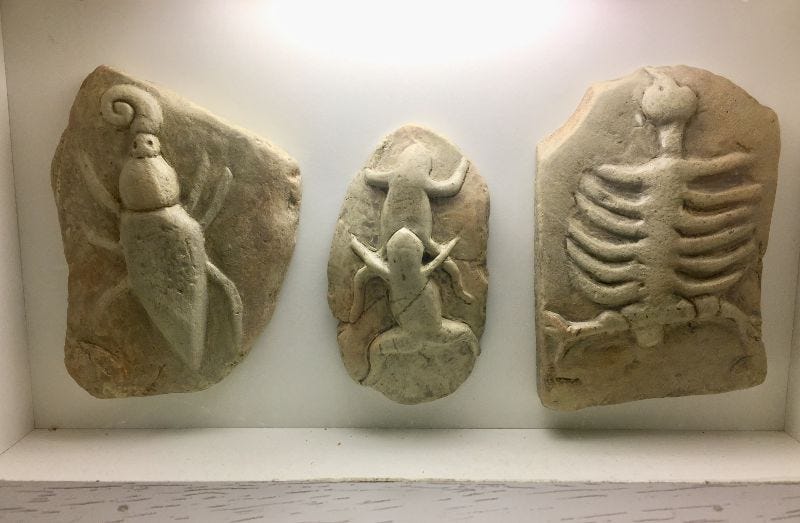

In reality, they were replicas, created and planted by his colleagues Jean Ignace Roderique and Johann Georg von Eckhart to prank him. They look very obviously fake, but that only made Beringer more convinced that they were real. You see, Beringer believed that fossils were placed on Earth by God, and finding handmade “fossils”, some of which even included Hebrew inscriptions, only strengthened his conviction. He thought this was the most amazing find, worthy of publishing an entire book about. Beringer only realised after the book’s publication that it had all been a hoax.
But why did nobody stop him? Well, first of all, he wasn’t very popular. According to his prankers, “he was so arrogant and despised us all”. But also, people did try to warn him! His friends realised that this must surely be a prank and tried to warn him against publishing the book, but he did it anyway, only to embarrass himself.
Maybe there’s a lesson in here about always listening to feedback before you publish anything, but I just thought it was a funny story. Imagine getting pranked so hard that people are still talking about it 300 years later.
Science on the internet
A single European robin made it to Canada and the birdwatchers are all over it. (For reference, this is such a common bird in the UK!) Covered by Danielle Beurteaux for The Guardian
“It ain’t no unicorn”. The Conversation spoke to researchers Jamie Lewis and Andy Bartlett about their interviews with Bigfoot hunters.
How much water does AI really use? Molly Taft spoke to experts for Wired (republished without paywall in Undark)
Can science still afford serendipity? asks Sneha Khedkar in The Scientist
The common way to treat appendicitis is to just remove the whole appendix, but a new study suggests that antibiotics could do the trick. By Laura Dattaro for Science News